The Fourth Man
Before they robbed a Stuttgart bank in 1883, four men ate a sausage and drank a beer. One of them got away.
- StellmacherAnarchist. Handed out the bombs and hammers.
- KammererAnarchist. Had killed a pharmacist in Strasbourg four weeks before.
- Michael KumitschKept watch in the street. Arrested that night in Pforzheim. Sentenced to life.
- HeilbronnerBanker. A gaping wound on his forehead.
- Louis OettingerSkull broken, artificial leg torn off. Survived, disfigured for life.
Follow the trail
Fifteen clues, from the robbery in 1883 to the last trace of the fourth man. Step through them in order.
-
Four men, 17,000 marks
Four men force their way into the banker Heilbronner's office at Kronprinzstraße 12. They strike him and his friend Louis Oettinger with lead hammers and leave with about 17,000 marks. That same night, Kumitsch, who kept watch in the street, is arrested in Pforzheim.
FindingOne man in custody. Three are free.
-
Two more names
Vienna newspapers name two of the others: Stellmacher and Kammerer. They are the anarchists who killed the pharmacist Lienhard in Strasbourg four weeks before the robbery.
FindingThree of the four men have names.
-
A suspect in Basel
After a bomb attack on the police building in Frankfurt, the Frankfurt police suspect a Josef Richetzki. He lives in Basel, at Zimbergäßli 8.
FindingNobody connects him to the robbery in Stuttgart.
-
“Whose name he did not know”
At his trial, Kumitsch says only that a fourth man joined them, „dessen Namen er nicht kenne“, whose name he did not know. He is sentenced to life in prison.
FindingThe fourth man has no name.
-
“Has remained unknown”
The Swiss federal prosecutor tells a meeting of workers that the four men planned their crimes from Switzerland: Stellmacher, Kammerer, Kumitsch, „und ein vierter, dessen Namen unbekannt geblieben ist“, and a fourth man whose name has remained unknown.
FindingBy now, the Frankfurt police have held the name for more than a year.
-
A face in the photographs
A court in Tübingen, investigating a different robbery-murder, questions Kumitsch in prison. He is shown a series of photographs and is not told which man is suspected. He picks out Josef Richetzky.
FindingThe fourth man has a name.
-
“Gritzi”
Why did the name take eight years? The investigating judge explains it in one sentence:
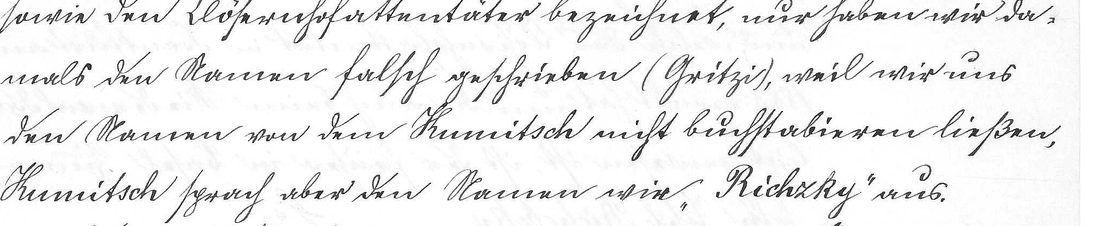
The judge's report, E 323 I Bü 6, image 57. „nur haben wir damals den Namen falsch geschrieben (Gritzi), weil wir uns den Namen von dem Kumitsch nicht buchstabieren ließen, Kumitsch sprach aber den Namen wie ‚Richzky‘ aus.“
The name was written down as “Gritzi” because nobody had Kumitsch spell it. He had said “Richzky”.
FindingGritzi is Richetzky.
-
Nobody believes him
The chief federal prosecutor in Leipzig answers that convicts often make such “revelations” and sees no reason to reopen the case. In Strasbourg, witnesses are shown Richetzky's photograph and give nothing to act on.
FindingThe name leads nowhere.
-
What he looked like
- Height
- Medium
- Build
- Slim
- Hair
- Short, blond
- Beard
- Long, full
- Glasses
- Usually gold-rimmed
FindingA description, but no address.
-
Case closed
Nobody knows where Richetzky is. The Stuttgart prosecutor closes the case.

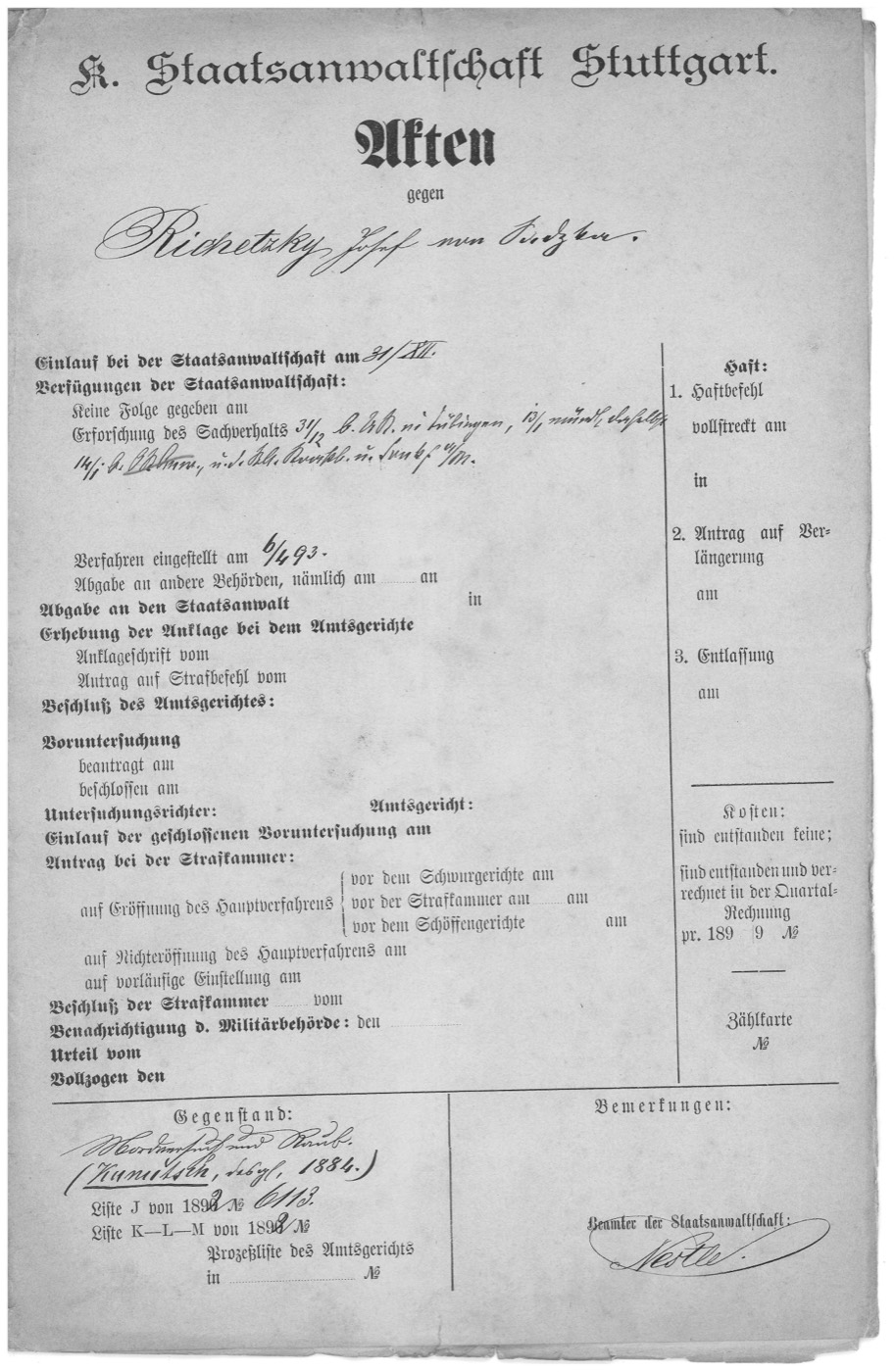
„Verfahren eingestellt am 6/4 93“, proceedings closed on 6 April 1893. The file cover, image 2. FindingThe file stops here. Its police letters hold one more lead.
-
“Mr Charles Jäger”
A police letter in the file reports that Richetzky lives in New York as “Mr Charles Jäger”, a tailor at 147 E. 32nd St.

„Josef Richetzky Mr Charles Jäger 147. E. 32 Str. New York City“. Frankfurt police, 7 January 1892, quoting a letter of 12 December 1886. Image 27. FindingAn alias, a trade, and an address.
-
A tailor at the same address
A son is born in New York in 1886. The father is Charles Jaeger, tailor, born in Prague, aged 40, living at 147 E. 32nd St. In 1888 a daughter, Martha, is born to the same parents.
FindingSame name, same trade, same address.
-
The trail goes west
Charles Jaeger moves from New York to San Francisco in 1888 and becomes a US citizen there in 1890. By 1900 he is a merchant tailor in San Rafael, with his Swiss wife and Martha.
FindingSame name, same trade, now on the other coast.
-
Born in 1846
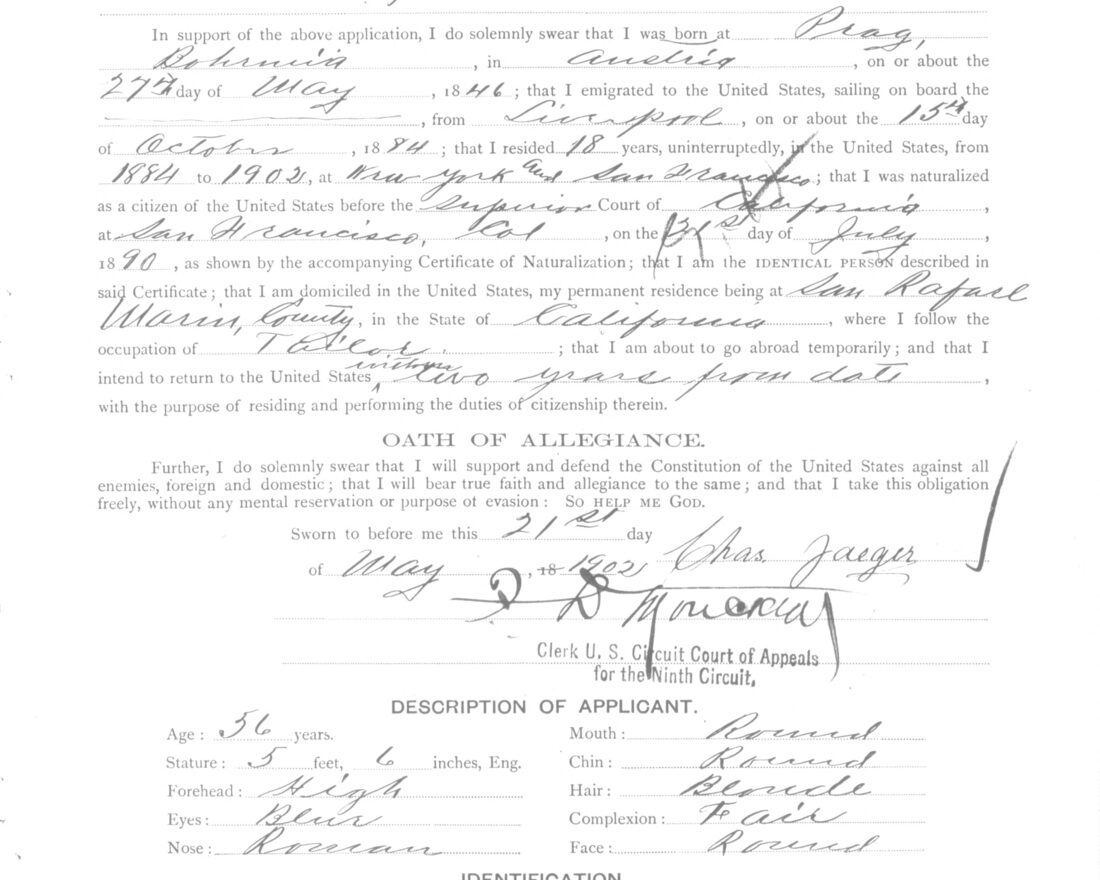
Under oath, for a passport, he gives his birthplace as Prague and his birthday as 27 May 1846, and says that his ship left Liverpool in October 1884. The file gives 1846 as Richetzky's birth year. Beside the oath, a clerk notes his height, 5 feet 6 inches, and his blonde hair.
FindingThe same birth year as the man in the file.
-
Never caught
The 1920 census finds him in San Francisco, aged 73 and widowed, still a tailor. On 22 September 1929 a Charles Jaeger dies there at 83, exactly the age that a birth on 27 May 1846 gives.
The fourth manJosef Richetzkyof Basel, as Charles JaegerNo American record names Richetzky. The link rests on what the file says about him, and the American records match it. For the 1929 death, only an index entry has been seen; the certificate is still unchecked.
The full story
At dusk on 21 November 1883, four men met near the palace in Stuttgart. There Stellmacher handed one of them, Michael Kumitsch, two bombs and pressed a lead hammer on him, which Kumitsch pushed into his trousers. Only that afternoon Stellmacher had talked of borrowing money from a shoemaker he knew. Then the four went into an inn for their sausage and glass of beer.
From the inn they walked to the Kronprinzstraße, where Stellmacher said he had scouted two banks. Three of the men forced their way through both doors of the banker Heilbronner's office at number 12 and struck Heilbronner and his friend Louis Oettinger, who happened to be there, on the head with lead hammers. Kumitsch kept watch in the street and then followed them inside. They left with about 17,000 marks.
Heilbronner was left with a gaping wound on his forehead, but by early January he was out of the Katharinenhospital and back at work. Oettinger's skull was broken, the struggle had torn off his artificial leg, and for weeks he was not expected to live. He survived, disfigured for life.
Kumitsch was arrested in Pforzheim that same night. By the time of his trial in June 1884, Vienna newspapers had named two of the others as Stellmacher and Kammerer, the anarchists who had killed the pharmacist Lienhard in Strasbourg four weeks before the robbery. Only the fourth man still had no name. At the trial Kumitsch said just that a fourth man had joined them, „dessen Namen er nicht kenne“, whose name he did not know, and he was sentenced to life in prison.
A year later the Swiss federal prosecutor in charge of the anarchist case summed up his findings for a meeting of workers in Bern. Stellmacher, Kammerer, Kumitsch, „und ein vierter, dessen Namen unbekannt geblieben ist“, and a fourth man whose name has remained unknown, had planned their crimes from Switzerland.
In 1892, still serving his sentence in the Stuttgart prison, Kumitsch named him.
1.0 The file
That name survives in file E 323 I Bü 6 of the Stuttgart public prosecutor's office, now in the state archive at Ludwigsburg. Its 60 pages from 1892 and 1893 are online as public domain, and the finding aid sums up the case in a single paragraph: the accused, Josef Richetzky, formerly of Basel, was said to belong to an anarchist group behind murders in Strasbourg, a bank robbery in Stuttgart, and the attack on the Niederwalddenkmal, and the case was closed on 6 April 1893 because nobody knew where he was.
Every page is written in Kurrent, the German handwriting of the time, which few people can read today. We found no published transcription. How we read it is explained in the appendix.
2.0 A name, eight years later
In 1892 the court at Tübingen was investigating a different robbery-murder and questioned Kumitsch in prison. By then, the investigating judge wrote, he had become „vollständig reuig“, completely repentant. He was well aware that statements from prisoners who want to seem important deserve „das größte Mißtrauen“, the greatest mistrust. „Trotzdem zweifle ich an der Richtigkeit der Angaben des Kumitsch nicht,“ he went on. Even so, I do not doubt that what Kumitsch says is correct.
His confidence rested on two things. Kumitsch had been shown a series of photographs without being told which man was suspected, and he picked out Richetzky. Even before the judge had heard that name, Kumitsch had described the same man as the third participant in Strasbourg, the fourth in Stuttgart, and the man behind a bomb attack on the police building in Frankfurt.
A single sentence from the judge explains why the name had not surfaced sooner:
„nur haben wir damals den Namen falsch geschrieben (Gritzi), weil wir uns den Namen von dem Kumitsch nicht buchstabieren ließen, Kumitsch sprach aber den Namen wie ‚Richzky‘ aus.“
Except that we wrote the name down wrongly at the time, as “Gritzi”, because we did not have Kumitsch spell it; he pronounced it like “Richzky”.

Richetzky's name had in fact been in police files since May 1884, when the Frankfurt police suspected a Josef Richetzki, then living in Basel at Zimbergäßli 8, of the bomb attack in Frankfurt. Throughout the interrogation record he appears only as “Gritzi”.
3.0 Kumitsch's account
All of these details come from Kumitsch's own statement: the sausage, the beer, the hammer. A copy survives in the file, and it reads as a calm list of small facts.
He spent the afternoon of 21 November in the Alexanderstraße with Kammerer, while Stellmacher and Gritzi kept fifty paces ahead, until he lost sight of them halfway down the street. After the attack he and Gritzi made for the station together. „Obwohl ich vor Aufregung am ganzen Leib zitterte“: although he was shaking all over, Kumitsch bought cigars and lit one so that he would look like a man out for a walk. Gritzi had put on glasses so that nobody would know him.
4.0 The money
The police took Kumitsch off the night express at Pforzheim carrying 1,000 marks from the robbery. He gave his name as Friedrich Baum, a locksmith from Chemnitz. We found no report that any of the remaining money or securities was ever recovered.
Stellmacher went straight back to Zürich. Kammerer followed by way of Schaffhausen to hand his share to „den Administrator Stellmacher“, the administrator Stellmacher, who managed the group's finances. In his confession in Vienna in 1884, Kammerer said he had burned the coupons, because every one of them carried Heilbronner's stamp on the back. The bonds, and whatever cash he did not need himself, went to Stellmacher.
Then he accused his partner of betraying the cause. Stellmacher, he said, had passed none of the money on to the party and must have kept it for himself. Neither of them had long to spend it. Stellmacher was hanged in Vienna on 8 August 1884, Kammerer on 20 September.
5.0 The doubts
Not everyone believed him. Writing from Leipzig on 26 November 1892, the chief federal prosecutor answered that convicts often make such “revelations”, that none had yet given usable results, and that he saw no reason to reopen the case. In March 1893 the prosecutor in Strasbourg showed Richetzky's photograph to witnesses there, found nothing to act on, and did not prosecute.
From Vienna came a police description dating from 1890: medium height, slim, short blond hair, a long full beard, and usually gold-rimmed glasses. Nobody knew where Richetzky was, and on 6 April 1893 the Stuttgart prosecutor closed the case.
6.0 The fourth man
When the Swiss federal prosecutor told his audience in Bern in July 1885 that the fourth man's name had remained unknown, the Frankfurt police had held it for more than a year. Since May 1884 their file on the bomb attack in Frankfurt had named a Josef Richetzki of Basel. Nothing in the file links him to the robbery in Stuttgart before 1892, when Kumitsch picked his face out of a set of photographs.
In Kumitsch's account, Gritzi walks with him through Stuttgart until he can no longer miss the station, then goes on ahead. The file never catches up with him.
7.0 Chronology
- Stellmacher and Kammerer kill the pharmacist Lienhard in Strasbourg.
- Four men rob the banker Heilbronner in Stuttgart. Kumitsch is arrested that night.
- Frankfurt police suspect a Josef Richetzki of Basel of a bomb attack in Frankfurt.
- Kumitsch is sentenced to life. He says he does not know the fourth man's name.
- The Swiss federal prosecutor says the fourth man's name has remained unknown.
- In prison, Kumitsch picks Richetzky out of a set of photographs.
- The chief federal prosecutor in Leipzig sees no reason to reopen the case.
- Witnesses in Strasbourg give nothing to act on.
- The Stuttgart prosecutor closes the case. Richetzky's whereabouts are unknown.
8.0 San Francisco
The file never catches up with him, but two of its police letters say where to look. In January 1893 the Vienna police wrote of „der Anarchist Josef Richetzky, fälschlich Charle Jäger“, the anarchist Josef Richetzky, falsely called Charles Jäger: a tailor, born in Sadská in 1846. An older letter copies the address he had sent his sister in December 1886: „Josef Richetzky Mr Charles Jäger 147. E. 32 Str. New York City“.
New York recorded the same house. On 21 May 1886 a boy named August was born at 147 East 32nd Street. His father was Charles Jaeger, a tailor of 40, born in Prague, Bohemia, and his mother came from Zürich. In 1890 an anarchist told the Frankfurt police that the tailor Jäger had a Swiss wife and had moved on to Cleveland and then to San Francisco. „Möglicher Weise hält sich Richetzky auch jetzt noch in San Francisco auf,“ the Frankfurt police president wrote in January 1892: possibly Richetzky is still in San Francisco.
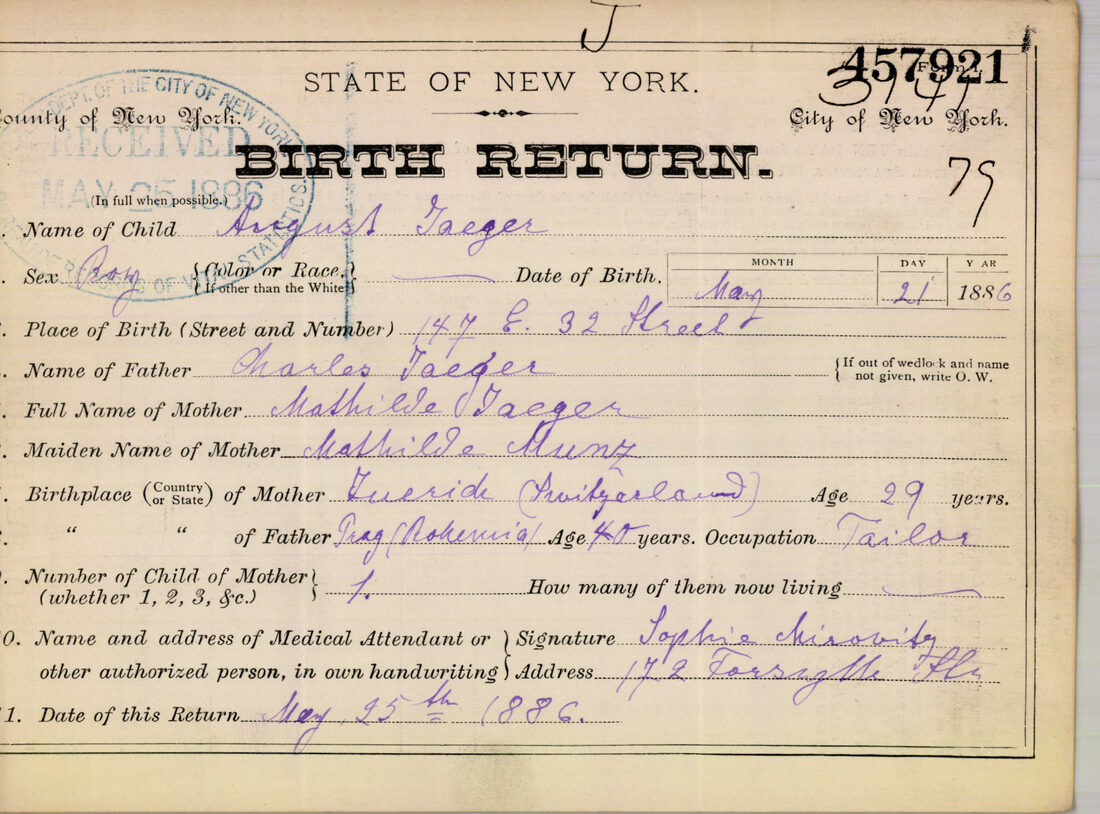
American records follow a Charles Jaeger, tailor from Bohemia, from that address to San Francisco.
| Year | Place | Record |
|---|---|---|
| 1886 | New York | Son August born at 147 E. 32nd St. Father Charles Jaeger, tailor, born in Prague, 40. |
| 1886 | New York | The file's police letters: Richetzky lives there as “Mr Charles Jäger”, a tailor. |
| 1888 | New York | Daughter Martha born. Same parents. |
| 1890 | San Francisco | Becomes a US citizen. |
| 1897 | San Rafael | Registers to vote. Tailor, 5 ft 6 in, light hair, blue eyes. |
| 1900 | San Rafael | Merchant tailor, with his Swiss wife and Martha. |
| 1902 | San Francisco | Applies for a passport. Born in Prague, 27 May 1846. Sailed from Liverpool in October 1884. |
| 1914 | New York | Applies for a passport with his wife, Caroline. Lived in New York 1884 to 1888, then in San Francisco. |
| 1920 | San Francisco | Aged 73, widowed, still a tailor. |
No American record names Richetzky. The link rests on the file: its letters give an alias, a trade, a birth year, a New York address, and a Swiss wife, and the American records match every one.
On 21 May 1902, nine years after Stuttgart closed the case, Charles Jaeger stood before a federal court clerk in San Francisco and swore to the facts of his life. Prague was his birthplace, 27 May 1846 his birthday. His ship had left Liverpool around 15 October 1884, five months after the Frankfurt police had placed Richetzky in Basel. Tailoring was still his trade and San Rafael his home, and he meant to go abroad for up to two years.
The clerk then described the applicant: five feet six inches, blue eyes, fair complexion, blonde hair. At the foot of the oath he signed “Chas. Jaeger”.
In April 1914 he applied for another passport, this time in New York and with his wife, Caroline. He gave the same birthday and the same crossing, and one more fact: he had lived in New York until 1888 and in San Francisco after that. An anarchist had told the Frankfurt police in 1890 that Jäger left New York at the end of 1888.
In January 1920 the census found him lodging in a house in San Francisco, 73 and widowed, still working as a tailor in a men's tailor shop. A Charles Jaeger died in the city on 22 September 1929, aged 83, which is the age that a birth on 27 May 1846 gives. No other Charles Jaeger appears in the California death indexes for 1928 to 1930, and none born in the 1840s turns up in the 1930 census. Until someone checks the death certificate, this last step remains very likely rather than certain.
Stuttgart had closed the case because nobody knew where he was. In 1902 he gave the State Department his address: P.O. Box 95, San Rafael, Marin County.
A.1 How we read it
Kurrent Transcriber 1B, the open model for German handwriting from 13fragments, read all 60 pages offline on an M1 MacBook Pro. Reading them took about 12 minutes, and no page left the laptop.
A professional transcriber is now reading 23 of the pages independently, without seeing the model's text, so that the two readings can be compared word by word. That review is not finished. Until it is, the quotations in this post come from the model's reading, and we checked the key passages against the scans ourselves. Once the review is done, the error count and the corrected transcription will follow here.
Status: professional review in progress. Quotations are machine readings checked by us against the scans.
A.2 What we could not confirm
What the file records is an accusation made by a convicted man. Leipzig's chief prosecutor did not believe it, the witnesses in Strasbourg gave nothing, and whether Richetzky took part in any of the crimes remains unknown. Even the spelling is unsettled: the archive's online finding aid lists the accused as “Josef Richetzly”, while the cover of the file reads Richetzky.
The American records do not prove that Charles Jaeger was Richetzky. They show that a tailor with his alias, his birth year, and his New York address lived in California until at least 1920. The 1929 death matches in age and place, but its certificate is still unchecked.
The account of the money comes from newspaper reports of 1884 on Kammerer's confession, which we read as machine-read text. We have not seen those pages as images, and the confession itself is not in the Stuttgart file.
Nor is it certain that nobody has written about him before. A search on 18 November 2026 covered the German newspaper portal, the Austrian newspaper archive ANNO, and the Swiss archive e-newspaperarchives.ch for the years 1883 to 1900, along with the standard history of the anarchist movement in Switzerland, published in 1903. None of them names Richetzky in this case. These searches rely on machine-read text, which misses words, so if you know an earlier publication, please tell us at [email protected].
A.3 What the model got wrong
Clean chancery copies gave the model little trouble, but a faint stamp of the Stuttgart prosecutor's office did. For the same stamp it wrote different place names on different pages, among them “Saltzburger”, “Schaffhausen”, and “Schleswagen”. It also wrote “₽” for the number sign “№” on printed forms, and in the Vienna letter it read Richetzky's year of birth, 1846, as 1876. Anything else it got wrong will show up in the professional review, and the corrected transcription will list every change.
A.4 The American records
We read these records on the scans ourselves. No professional has checked them yet.

